
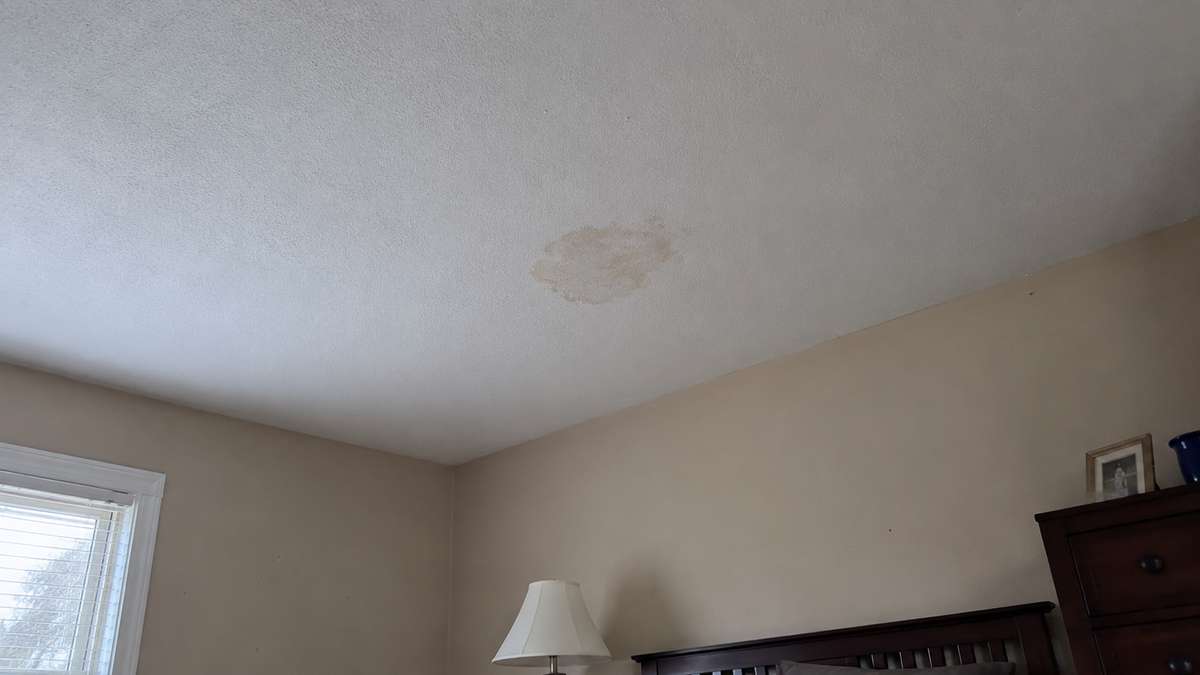
- A ceiling stain is rarely directly below where water actually entered. Water travels along the roof deck and framing before dripping, which is why patching above the stain often doesn't fix the leak.
- A sudden jump in granules collecting in gutters, especially on an older roof or after a hailstorm, is an NRCA-flagged warning sign worth a closer look, even without an active leak yet.
- Leaks that only appear during wind-driven rain, not ordinary rainfall, often point to a different failure mechanism than leaks that show up every time it rains. The pattern itself is diagnostic information.
- Not every damp attic is a roof leak. Warm indoor air condensing on a cold roof deck in winter can mimic leak symptoms, which is part of why Wisconsin requires balanced attic ventilation and R-49 insulation (SPS 322.39).
A roof leak rarely starts with water pouring through the ceiling. More often, it starts with a faint brown spot, a musty smell in the attic, peeling paint near an exterior wall, or a few damp inches of insulation that nobody notices until the problem has been there for months.
That is what makes early detection so valuable. Catching a failed piece of flashing or a small shingle leak can mean a relatively straightforward repair. Letting water repeatedly soak roof decking, insulation, drywall, and framing can turn the same leak into a much larger project. The National Roofing Contractors Association recommends regular roof inspections specifically because cracked or missing shingles, deteriorated flashing, excessive granules, and interior discoloration can reveal problems before serious damage develops.
The 7 Early Signs of a Roof Leak
1. Brown or Yellow Stains on the Ceiling
This is the classic roof-leak warning sign, but it does not always look dramatic.
You may first notice a faint tan ring, a slightly darker patch of drywall, or discoloration that seems to appear only after heavy rain.
Do not assume a small stain means a small problem.
Drywall may show visible damage only after water has already passed through roofing material, roof decking, insulation, and the ceiling cavity above it.
Also, the stain is not necessarily directly underneath the point where water entered the roof. Water can travel along the underside of the roof deck, framing, pipes, or other surfaces before finally dripping onto the ceiling.
That is why simply putting roofing cement directly above an interior stain does not reliably solve a leak. The actual water-entry point has to be identified.
Professional roof-leak investigations focus on tracing the water path rather than assuming the visible interior damage is directly below the roof failure, according to guidance published by the National Roofing Contractors Association.
2. Peeling Paint or Bubbling Drywall
Water does not always create a neat brown circle.
Watch for:
- Bubbling ceiling paint
- Peeling paint near the top of a wall
- Soft or swollen drywall
- Cracking paint
- Wallpaper beginning to release
- Discoloration around ceiling joints
These signs are especially important on the upper floor of the house or near exterior walls. The National Roofing Contractors Association specifically identifies cracked paint, discolored drywall, and peeling wallpaper as possible interior signs of roofing problems.
If an area changes appearance after a rainstorm and then seems to dry out, do not assume the problem solved itself. Intermittent leaks often appear only when rain comes from a particular direction or when wind pushes water into a vulnerable roof detail.
3. A Musty Smell in the Attic
You may smell a roof leak before you see one.
A persistent damp or musty odor in the attic can indicate moisture is getting into insulation, wood, or other materials.
Open the attic access and look around during daylight.
You are looking for:
Dark staining on the roof deck. New or irregular water staining deserves attention.
Damp insulation. Insulation underneath an active leak may feel wet or appear compressed.
Water marks on rafters or trusses. These can sometimes help trace where moisture has been traveling.
Visible daylight. If daylight is entering through an unexpected roof opening, water may be able to follow.
Do not assume every damp attic is caused by a roof leak, however. Wisconsin homes can also experience attic moisture problems caused by warm, humid indoor air entering a cold attic.
That distinction becomes especially important during winter.
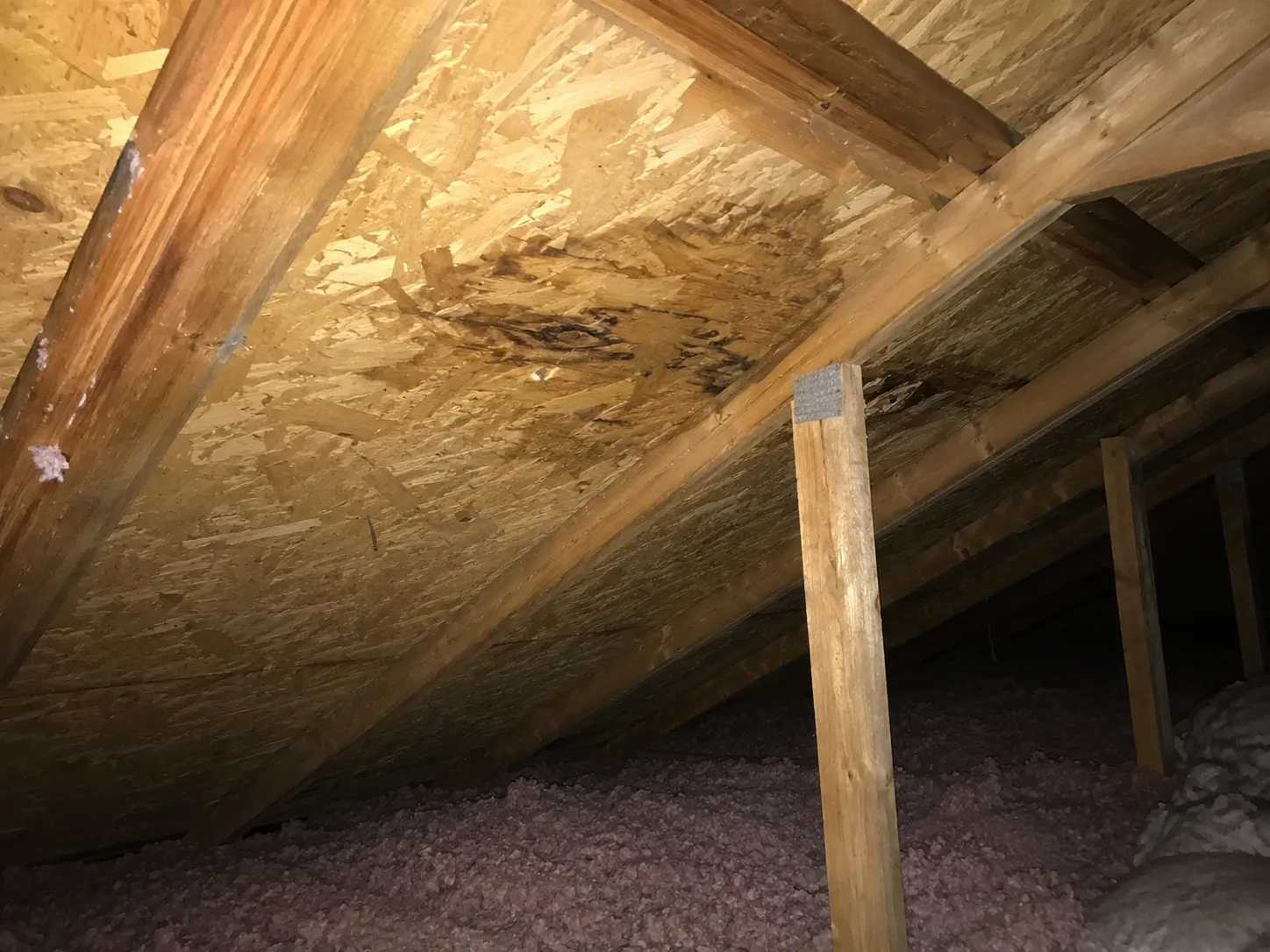 Checking the roof deck and insulation from inside the attic can reveal a leak before it reaches the ceiling.
4. Missing, Lifted, or Damaged Shingles
You do not need to climb onto the roof to notice some problems.
Stand far enough away from the house to see the roof safely and look for sections that appear different from the surrounding shingles.
You may notice:
- A shingle completely missing
- A tab lifted out of position
- An exposed area underneath the shingles
- Bent or damaged ridge shingles
- A roof edge that looks uneven after a windstorm
- Shingle pieces in the yard
Wind does not have to remove a large section of roofing before water becomes a concern.
Wind forces can lift roofing materials and exploit vulnerable sections of the roof covering. Once the roof covering is compromised, wind-driven rain has another path into the roofing assembly, according to research from the Insurance Institute for Business & Home Safety.
If shingles suddenly appear in your yard after a Milwaukee thunderstorm, that is worth investigating even if the ceiling is still dry.
5. Granules Collecting in Your Gutters
Asphalt shingles have a mineral granule surface.
Finding a few granules does not automatically mean the roof is failing. Some granule loss occurs over the life of an asphalt roof.
What matters is a noticeable change.
If gutters or downspouts suddenly contain significant amounts of roofing granules, particularly on an older roof or after a hailstorm, the shingles deserve a closer look. The National Roofing Contractors Association lists excessive granule accumulation in gutters and downspouts among the visible conditions homeowners should watch for during roof maintenance.
Granule loss by itself does not prove that you have a leak. It is a warning sign that the condition of the shingles should be evaluated.
6. Water Around Chimneys, Vents, or Skylights
Many roof leaks do not begin in the middle of an uninterrupted field of shingles.
They begin where something interrupts the roof.
Common areas include:
Chimneys. Flashing has to manage the transition between roofing and masonry.
Plumbing vents. Boots and seals around vent pipes can deteriorate.
Skylights. The flashing system around the opening has to direct water around it.
Roof-to-wall intersections. Water needs to be directed away from the point where roofing meets siding or another wall.
Valleys. Two roof slopes send water into the same channel, making proper installation particularly important.
If you repeatedly see water in the same general area during storms, the surrounding flashing and roof transitions are often more useful places to investigate than the shingles alone.
A leak caused by one localized flashing problem does not necessarily mean you need a new roof. The National Roofing Contractors Association notes that leaks can result from loose flashing or damage limited to one section of the roof rather than complete roof-system failure.
7. A Leak That Appears Only During Certain Weather
Some of the hardest roof leaks to diagnose are the ones that do not happen every time it rains.
Maybe the ceiling stays completely dry during an ordinary all-day rain but develops a spot during a severe thunderstorm.
That is useful information.
Wind-driven rain can enter through openings that do not leak under normal rainfall. Research by the Insurance Institute for Business & Home Safety has demonstrated how wind can drive water through vulnerable areas of roofing systems once the roof covering or other components are compromised.
Other leaks may appear during snowmelt rather than rain.
Pay attention to the conditions when the problem occurs:
- Heavy rain
- Wind from a particular direction
- Hail or severe thunderstorms
- Snow melting
- Rapid temperature changes
- Ice buildup along the roof edge
The pattern can help narrow down what is happening.
Where Roof Leaks Commonly Start
Finding water inside does not automatically tell you where to look outside.
Several roof areas deserve particular attention.
Flashing
Flashing protects transitions and openings where roofing material alone cannot reliably keep water out.
If flashing becomes loose, damaged, improperly installed, or separated from surrounding materials, water can work behind it.
Flashing repairs commonly run around $10 to $20 per linear foot, depending on the location and scope of work.
That is considerably cheaper than allowing a small flashing leak to repeatedly wet the roof deck.
Valleys
Roof valleys handle concentrated runoff from multiple slopes.
Leaves and debris can collect there, roofing materials can deteriorate, and installation problems become particularly important because so much water passes through the area.
Roof Penetrations
Every pipe, vent, chimney, or skylight creates an interruption in the roof covering.
The roofing system has to seal and redirect water around each one.
If you have a ceiling leak close to a bathroom, fireplace, or other area where a roof penetration is likely above it, the penetration deserves inspection.
Roof Edges
The eaves are especially important in Wisconsin.
Winter snowmelt can reach the colder edge of the roof and refreeze. Water can then work beneath shingles if ice buildup interferes with normal drainage.
Wisconsin code requires ice-and-water-shield membrane on asphalt shingle roofs with a 4:12 slope or shallower over heated space, extending at least 30 inches up from the roof edge and 12 inches past the interior wall face (Wisconsin DSPS, SPS 321.28).
The membrane adds protection if water gets beneath the roofing material, but it does not mean recurring ice or water problems should be ignored.
One More Wisconsin Factor: Roof Leak or Attic Condensation?
This is one of the more confusing winter problems for Milwaukee homeowners.
You open the attic and find damp wood or moisture. Naturally, you assume the roof is leaking.
Sometimes it is.
Sometimes the moisture is coming from inside the house.
Warm, humid indoor air can move into the attic during winter. When that moisture reaches cold roof surfaces, it can condense or even form frost.
Then temperatures rise.
The frost melts.
Suddenly you have water staining or dripping that looks very much like a roofing leak, even though there was no rain outside.
Several clues can help distinguish the two.
A roof leak is often localized. You may find a defined water trail beneath flashing, a valley, damaged shingles, or another specific roof area.
Condensation may be more widespread. Moisture or frost can appear across larger sections of roof decking or around roofing nails.
Weather matters. Water appearing during or immediately after rain points more strongly toward exterior water intrusion. Moisture appearing during very cold conditions or a warm-up after prolonged freezing can point toward an attic moisture problem.
Wisconsin requires balanced soffit intake and ridge exhaust attic ventilation (Wisconsin DSPS, SPS 322.39), and the Wisconsin Energy Code calls for minimum R-49 attic insulation in Climate Zone 6, which covers the Milwaukee metro.
Ventilation and insulation both matter because a Wisconsin roof has to manage conditions from above and below.
Simply repairing shingles will not solve attic condensation if the actual problem is moisture movement, insulation, or inadequate ventilation.
When a Roof Leak Is an Emergency
Not every roof leak requires an emergency call.
A small ceiling stain discovered after last night’s rain can usually be investigated through a normal roofing appointment.
Other situations should be dealt with immediately.
Call for Immediate Help When:
- Water is actively pouring through the ceiling
- A tree or large branch has punctured the roof
- A large section of shingles or roofing has blown off
- The ceiling is sagging or bulging with water
- Water is entering around electrical fixtures
- Storm damage has left the roof visibly open to additional rain
If a ceiling is bulging with trapped water, do not stand underneath it.
If water is entering near electrical fixtures, outlets, or wiring, treat the situation as an electrical safety issue in addition to a roofing problem.
The priority is preventing additional water from entering the house and protecting people inside.
Temporary tarping or another emergency measure may be appropriate until permanent repairs can be made. Our emergency roof repair service is built for exactly this situation.
What You Should Do When You Find a Leak
1. Protect the Interior
Move furniture, electronics, rugs, and valuables away from the affected area.
Use containers to catch dripping water if it is safe to do so.
2. Take Photos
Photograph the ceiling stain, water, damaged belongings, fallen branches, visible exterior damage, and anything else connected with the event.
This is especially important if you suspect the leak resulted from wind or hail and homeowners insurance may become involved.
3. Note When It Happened
Write down when you first noticed the leak and what the weather was doing.
“Water stain appeared Tuesday” is useful.
“Water stain appeared during heavy wind-driven rain Tuesday evening after shingles were found in the backyard” is much more useful.
4. Check the Attic if You Can Do It Safely
You may be able to see wet decking, staining, dripping water, or damp insulation.
Do not walk between framing members or climb around an unsafe attic trying to locate the exact hole.
5. Do Not Climb Onto the Roof
A wet roof is not the place to troubleshoot a leak yourself.
The National Roofing Contractors Association recommends that most roofing work be handled by trained roofing professionals because improper techniques can damage the roof and falls can cause serious injury.
6. Get the Source Identified
A roofing contractor should determine what actually failed before recommending the repair.
That might be a few damaged asphalt shingles, which average roughly $250 to patch, or flashing that can be repaired for roughly $10 to $20 per linear foot.
It might also reveal a larger problem.
The point is to diagnose first. Our roof repair team can tell you exactly what’s needed once the source is confirmed.
A Small Leak Is Usually Cheapest the First Time You Notice It
The first visible sign of a leak is the best time to deal with it.
Water rarely improves roofing materials by being allowed to keep entering the house.
A localized flashing problem may be inexpensive to correct. If the same area repeatedly gets wet, you can eventually be dealing with damaged sheathing, wet insulation, ceiling repairs, paint, or other interior work in addition to the original roofing repair.
The visible stain is therefore not the problem you are trying to fix.
It is evidence that water has found a path through a system that is supposed to keep it outside.
If you see staining, peeling paint, missing shingles, wet attic materials, or another warning sign, do not wait for water to start dripping onto the floor before having it looked at.
Find the Leak Before You Fix the Damage It Caused
The most important thing to understand about a roof leak is that where you see the water and where the roof is leaking may not be the same place.
Water can enter around flashing, damaged shingles, valleys, roof penetrations, or storm-damaged areas and travel before finally becoming visible inside your house.
Start with the clues.
When did the moisture appear? What was the weather doing? Is the problem localized or widespread? Are shingles missing? Is there staining in the attic? Is the roof old enough that deterioration is becoming likely?
Then find the actual source.
Catching that source while the problem is still limited to the roof is almost always better than finding it after the roof deck, insulation, drywall, paint, and belongings underneath it have joined the repair list.
If you have spotted a ceiling stain, damp attic, missing shingles, or another sign of a possible roof leak, Milwaukee Roof Contractors can inspect the roof and identify where the water is getting in. We provide roof inspection, roof repair, emergency roof repair, roof replacement, and storm damage services throughout Milwaukee, Waukesha, and Ozaukee Counties, including Wauwatosa, West Allis, Mequon, Whitefish Bay, Glendale, Shorewood, Menomonee Falls, Cedarburg, Grafton, Brookfield, New Berlin, and surrounding communities.